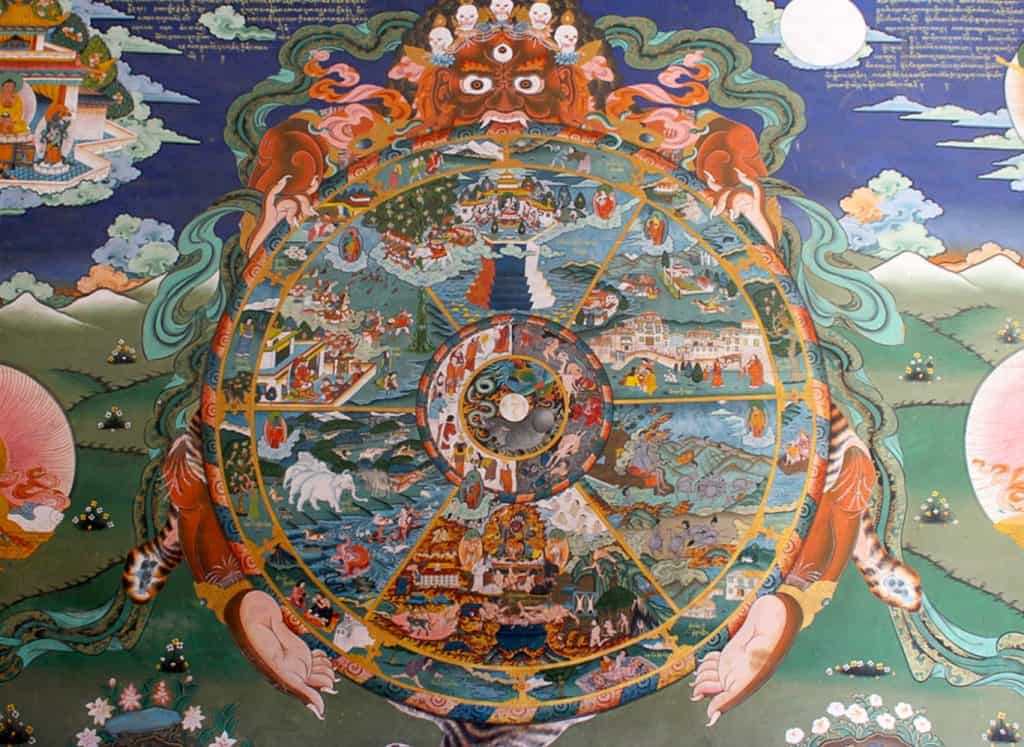
Rebirth is a fundamental concept in Buddhism that refers to the cycle of birth, death, and rebirth. According to Buddhist teachings, the actions of a sentient being lead to a new existence after death, in an endless cycle called saṃsāra. This cycle is considered to be unsatisfactory and painful, and the cycle stops only if liberation is achieved by insight and the extinguishing of craving.
Rebirth is closely tied to karma, intentional action and its consequences. Buddhist teachings connect wholesome and unwholesome intentions with different results, including future lives. This is not a simple ledger in which one action fixes an entire destiny. The wider path aims at freedom from the conditions that sustain samsara, not only a more pleasant rebirth.
Rebirth is a Buddhist teaching, not a scientific explanation of what happens after death. Traditional texts discuss lives beyond the present one. Readers may approach that claim with conviction, uncertainty or scepticism.
Understanding Rebirth in Buddhism
In Buddhist teachings, repeated birth and death are part of samsara. The cycle is described as dukkha because conditioned existence does not provide lasting security. Liberation, commonly called nirvana or nibbana, involves ending the craving and ignorance that sustain the cycle. The account includes future lives and is not only a metaphor for changing moods.
The Concept of Karma
Karma concerns intention and the actions of body, speech and mind that follow from it. The Buddha's explanation in AN 6.63 makes intention central. Karma is therefore not the name for every physical cause or every involuntary thought. Its results depend on conditions; Buddhist texts do not support judging a person's whole past from their current fortune.
The Five Skandhas
The Five Skandhas, or aggregates, are form, feeling, perception, mental formations and consciousness. They provide a way of analyzing changing experience. In discussions of rebirth, the question is how conditioned continuity is understood without turning any of these aggregates into a permanent soul that travels intact from one life to another.
Anatta or No-Self
Anatta, or non-self, means that none of the aggregates is a permanent, independently controlling self. Rebirth teachings therefore raise a question of continuity without an unchanging soul. The traditions explain that continuity in different ways, but consciousness is not an identical entity moving between lives in place of a soul.
Buddhists believe that the cycle of rebirth can be broken by following the Eightfold Path, which includes right understanding, right intention, right speech, right action, right livelihood, right effort, right mindfulness, and right concentration. By following the Eightfold Path, a person can achieve enlightenment and liberation from the cycle of rebirth.
English terms such as rebirth, reincarnation and transmigration are used differently by different writers. In MN 38, the Buddha rejects the claim that the very same consciousness wanders through successive lives and explains consciousness as arising through conditions. So Buddhists do not simply believe in a moving consciousness instead of a moving soul.
Accounts also differ between Buddhist traditions. Theravada commentarial analysis uses the term rebirth-linking consciousness, while Tibetan teachings discuss an intermediate state. Mahayana teachings on bodhisattvas concern the aspiration and capacity to benefit others; they do not mean every person choosing to delay rebirth.
Overall, rebirth is a central concept in Buddhism, which teaches that a person's actions have consequences that extend beyond their current life. By understanding the concepts of karma, the Five Skandhas, and Anatta or No-Self, a person can gain insight into the nature of rebirth and the importance of following the Eightfold Path to achieve liberation from the cycle of rebirth.
Practice in relation to rebirth
Rebirth teachings place present conduct within a longer account of consequences. Buddhist practice addresses the ignorance and craving that sustain samsara through ethical conduct, meditation and wisdom. The Four Noble Truths and Eightfold Path explain that training. Practitioners are not simply trying to repeat birth; liberation concerns freedom from its compulsive conditions.
Meditation Practice
Meditation is an essential practice in Buddhism, and it is used to develop insight into the nature of reality and to cultivate a sense of calm and tranquility. In the context of rebirth, meditation is used to develop an awareness of the impermanent and unsatisfactory nature of existence and to cultivate the insight necessary to break the cycle of samsara. Meditation can also help individuals develop a deeper understanding of the nature of their own minds and the habits and passions that drive their actions.
The Four Noble Truths
The Four Noble Truths are a cornerstone of Buddhist teaching and provide a framework for understanding the nature of existence and the path to liberation. The First Noble Truth is the truth of dukkha, which refers to the unsatisfactory and painful nature of existence. The Second Noble Truth is the truth of the cause of dukkha, which is craving and attachment. The Third Noble Truth is the truth of the cessation of dukkha, which is the attainment of nirvana. The Fourth Noble Truth is the truth of the path to the cessation of dukkha, which is the Eightfold Path.
The Eightfold Path
The Eightfold Path is a set of practices that are designed to cultivate wisdom, ethical conduct, and mental discipline. The Eightfold Path consists of Right Understanding, Right Intent, Right Speech, Right Action, Right Livelihood, Right Effort, Right Mindfulness, and Right Concentration. Following the Eightfold Path is essential to breaking the cycle of samsara and attaining liberation.
These practices connect understanding with conduct and cultivation of mind. Tibetan Buddhist explanations also discuss the bardo, an intermediate state between death and rebirth. That account is specific to the Tibetan tradition. Schools share themes of karma and liberation but explain the transition between lives differently.
Different Perspectives on Rebirth in Buddhism
Rebirth has an important place in Buddhist scriptures and traditions, though accounts of how it occurs are not uniform. The examples come from named traditions and texts. They do not describe what every contemporary Buddhist believes.
Mahayana Buddhism
Mahayana traditions connect the bodhisattva path with the intention to attain awakening for the benefit of beings. In his 2011 explanation of rebirth, the Dalai Lama distinguishes ordinary rebirth under karma and afflictions from the rebirth of advanced bodhisattvas through compassion and aspiration. This is a Tibetan Buddhist explanation, not a claim that every person can freely choose their next life.
Theravada Buddhism
Theravada commentarial analysis describes rebirth-linking consciousness within a conditional process. The commentary to the Discourse on Right View explains connections among consciousness, mentality-materiality and karmic conditions. The aim of the path remains the cessation of the conditions sustaining suffering and renewed existence.
Zen Buddhism
Zen practice often emphasizes direct attention to present experience, but this does not mean Zen reduces rebirth to the present moment. The Soto tradition publishes texts that discuss consequences in this life, the next life and later lives. Keizan's Record of the Transmission of Illumination provides one such example. Present practice and traditional future-life teachings coexist in these sources.
Across these accounts, dependent origination and the aggregates remain useful reference points. The aggregates describe aspects of conditioned experience; dependent origination examines the conditions for suffering and its cessation. Neither teaching requires an independently existing self behind the process.
The texts discussed here explain continuity through karma, consciousness and conditions, using those terms in specific doctrinal senses. The relation between an action and a later result is central. It does not require treating karma as a substance that can be accumulated, measured or transferred intact between lives.
Traditional discussions of rebirth include forms of existence beyond a single human life. They are religious accounts of samsara and liberation, not experimentally established natural law and not only psychological metaphor.
In conclusion, the concept of rebirth in Buddhism is a complex and essential aspect of the religion. While there are different perspectives on how it is understood and approached, the goal is always to achieve awakening and end the cycle of saṃsāra.
Explore Related Retreats & Guides
Study the Dharma with experienced teachers. Explore Buddhist meditation retreats worldwide.